
Delivery of a custom CRM or ERP project is an important milestone of each company and therefore it has to be treated carefuly. Failed deliveries may expose many problems of different kinds and severity. In worst cases, a bankrupcy of the company may happen.
To be objective, it must be mentioned here that deliveries fail for the reasons arising from both sides - both the supplier and also the customer. This is because such project shall always be treated as a mutual win-win. A failed delivery poses problems to both sides and a successfull delivery also awards both sides.
How to prepare for this? How to lead the project (on both sides) to be successful? To help with this, we in Hubleto prepared a matrix, or a framework, highlighting the most important aspects of the overall team culture. If members of your teams, both at customer's and supplier's sides, will bear these aspects in mind, the risk of failed delivery will decrease significantly.
We call it a APRICOT team culture.
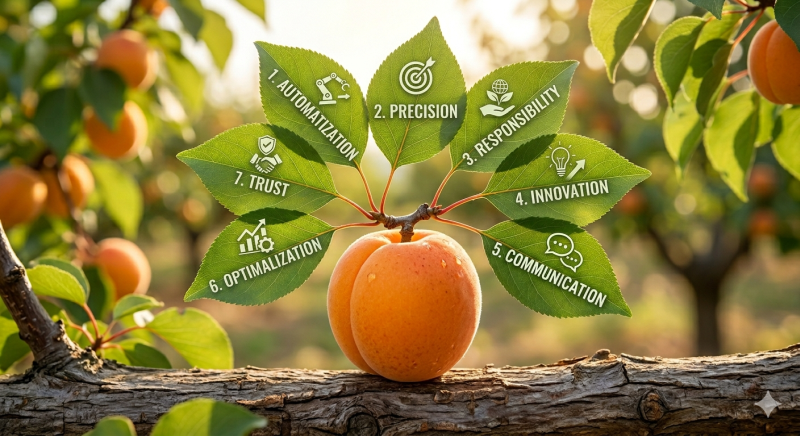
(source: www.pixabay.com, www.freepik.com, Google Gemini)
The 7 Pillars of Resilient Companies
The APRICOT team culture first specifies 7 basic pillars and for each pillar its daily focus and it's value for improving the crisis resilience:
- Daily Focus: Building tools and processes to handle repetitive operational workflows.
- Crisis Resilience Value: Allows the company to handle high volume without linearly scaling headcount/overhead.
The 4 Levels of Resilient Maturity
To turn your seven pillars into an effective tool, we structure this maturity model across four progressive stages. Moving from Level 1 to Level 4 represents a shift from reactive firefighting to built-in resilience.
- Level 1: Reactive (Fragile): Done ad-hoc. The trait only gets attention when something breaks or during a crisis.
- Level 2: Standardized (Stable): Documented and consistent within specific teams, but lacks cross-company integration.
- Level 3: Optimized (Resilient): Deeply embedded in daily company operations, data-driven, and capable of weathering market shocks.
- Level 4: Visionary (Anti-fragile): The company actively improves and grows stronger because of market volatility and stress.
The 7-Pillar Operational Goals Matrix
Use this matrix to identify where your organizational blind spots are before jumping into the interactive assessment below.
| Pillar | Level 1: Reactive | Level 2: Standardized | Level 3: Optimized | Level 4: Visionary |
|---|---|---|---|---|
| Automation | Manual workflows; developers spend time mostly on repetitive tasks. | Internal tools exist for daily tasks, but processes remain fragmented. | Workflows are fully automated across the tech stack. | Intelligent, autonomous workflows require zero manual input for baseline ops. |
| Precision | Buggy releases; metrics are vague or based on "gut feeling" only. | Established QA processes and clear KPIs, but testing slows down shipping speed. | Rigorous automated testing; decisions are driven by high-fidelity data pipelines. | Flawless execution with real-time error managment and healing systems. |
| Responsibility | Compliance is an afterthought; short-term profit overrides ethical concerns. | Legal and fiscal regulations are met, but strictly defensively.. | Ethical frameworks (AI governance, green hosting) are built into the business model. | Active industry leader in setting standards for ethics and sustainability. |
| Innovation | R&D happens only when products stagnate; heavy tech debt. | Dedicated R&D team exists, but they struggle to ship to production safely. | Structured pipeline for new ideas; tech debt is actively tracked and managed. | Continuous deployment; experimentation is decentralized across all teams. |
| Communication | Knowledge silos; information is hoarded; teams panic during a crisis. | Regular town halls and standard cross-team alignment meetings occur. | Radical data transparency; open documentation; fast decision-making. | Hivemind like organization; complete clarity in communication provides no alignment drag. |
| Optimization | Cost-cutting happens purely via panic-layoffs or sudden budget freezes. | Basic infrastructure and operational costs are tracked monthly. | Systems are set up for lean resource use; high working efficiency. | Dynamic, automated resource reallocation; margins improve as scale increases. |
| Trust | Blame culture internally; frequent customer churn due to data leaks/outages. | Psychological safety exists in pockets; basic security compliances are met. | High internal safety (blameless post-mortems); clear brand trust and data privacy. | Highest internal loyalty and customer advocacy that survives external crises. |
Do not underestimate the preparation
Never underestimate the preparation of the project. You are going to pay for a product that will be with you for next decades. It may boost your business up to the sky or it may bankrupt it.
Be very careful. We hope this matrix helps perfectly prepare all your teams (includig the supplier's teams) and get your business successfully running for its next period.