
For modern businesses, a CRM and ERP system is the beating heart of daily operations. With headlines regularly highlighting sophisticated cyberattacks, ransomware incidents, and even physical disruptions—such as kinetic missile or drone attacks targeting key data centers deciding where to host this critical software has never been more complicated
Cloud (SaaS) vs. Self-Hosted CRM & ERP: Which Path Secures Your Business Data in an Age of Cyber Threats and Physical Risks?
For modern businesses, a Customer Relationship Management (CRM) and Enterprise Resource Planning (ERP) system is the beating heart of daily operations. It houses your customer pipelines, financial records, internal workflows, and sensitive corporate data.
However, deciding where to host this critical software has never been more complicated. With headlines regularly highlighting sophisticated cyberattacks, ransomware incidents, and even physical disruptions—such as kinetic missile or drone attacks targeting key data center facilities and energy grid infrastructure in volatile regions—business owners are facing a tense dilemma. Is convenience worth the risk of entrusting all your proprietary data and critical operations to a remote data center, or is taking control via a self-hosted solution the smarter, safer bet?
If you are a business owner weighing these options, let's break down the advantages, disadvantages, and realities of both cloud (SaaS) and self-hosted CRM/ERP solutions—and look at how you don’t necessarily have to compromise.
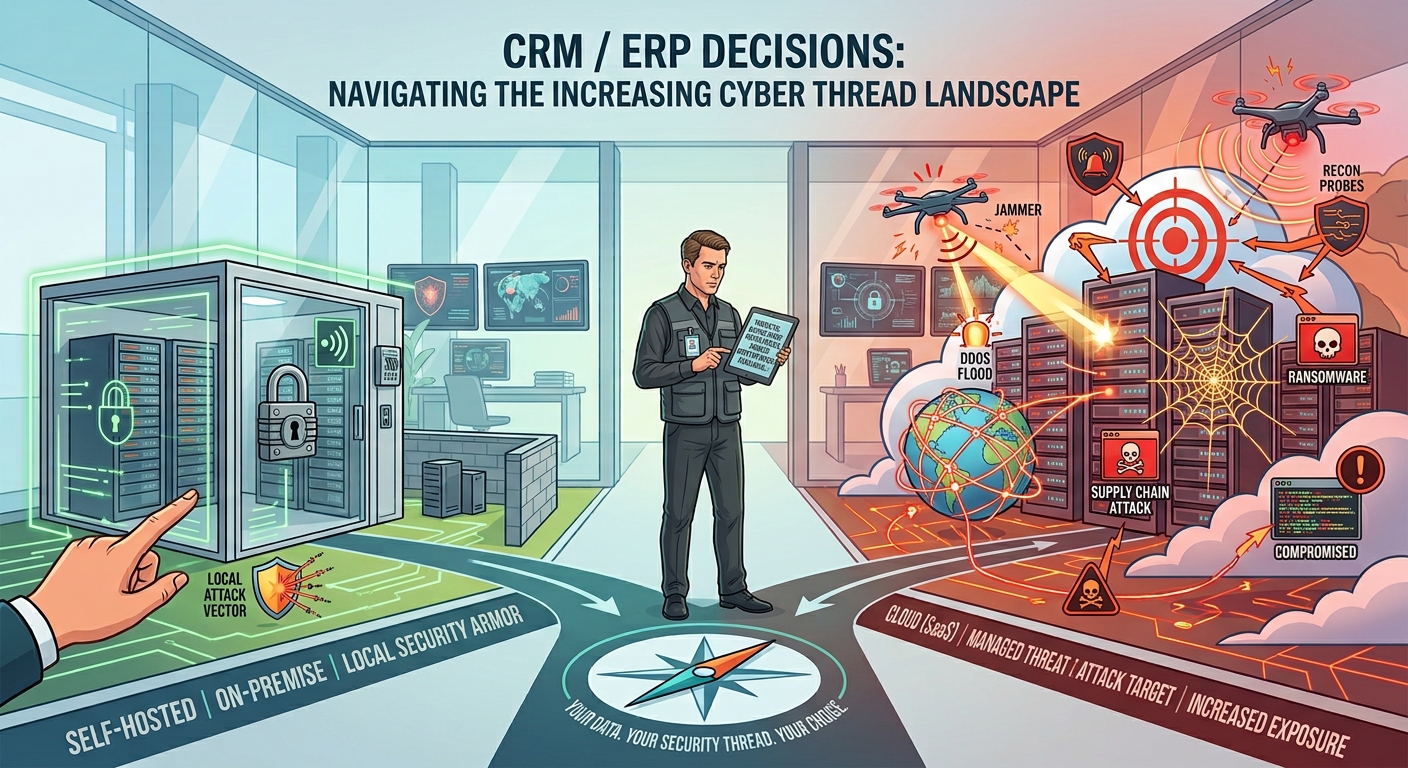
(source: www.pixabay.com, www.freepik.com, Google Gemini)
The Shifting Landscape: Cyber Vulnerabilities and Physical Threat Drivers
For years, the narrative was simple: move everything to the cloud because professional providers can secure data better than an internal IT team.
While large cloud providers invest heavily in perimeter defense and digital encryption, centralized multi-tenant data centers have become prime, high-profile targets—both online and offline:
- Cyber Risks: A single vulnerability in a major cloud infrastructure provider can expose thousands of downstream companies simultaneously to ransomware or supply chain exploits.
- Physical & Infrastructure Risks: Physical attacks on data center nodes, regional power grids, or subsea internet cabling—whether from targeted physical sabotage, missile strikes, or weaponized drone attacks in geopolitical hot zones—can instantly cut off access to cloud-hosted SaaS tools, halting business operations without warning.
Coupled with strict data sovereignty regulations (like GDPR) and the threat of unexpected physical or cyber downtime, business owners are increasingly asking: Do I really know where my data lives, how resilient the facility is, and who has access to it?
This concern has sparked a strong resurgence of interest in self-hosted solutions. But before making a decision, it helps to weigh the pros and cons of both models.
Cloud (SaaS) CRM & ERP: Maximum Convenience, Shared Risk
Software-as-a-Service (SaaS) has dominated the software market for a reason: it’s fast, seamless, and virtually hands-off for the end-user.
Advantages of Cloud (SaaS):
- Instant Deployment: You can sign up, log in, and start configuring your workflows in minutes without touching a line of code or setting up a server.
- Automatic Updates: New features, patches, and security updates are rolled out automatically by the vendor.
- Accessibility: Cloud systems are designed for mobile and remote work right out of the box, requiring only an internet connection.
- Predictable OpEx: Costs are spread out through manageable monthly or annual subscriptions without upfront hardware spending.
Create free Hubleto cloud account
Disadvantages of Cloud (SaaS):
- Vendor Lock-In: Migrating your data and workflows away from a proprietary SaaS platform can be difficult and costly.
- Third-Party Exposure: Your data lives on servers managed by external entities, exposing you to broader data center outages, telemetry tracking, or regional power/telecom failures.
- Less Granular Control: You must trust the vendor’s security posture and facility safety, which you cannot customize or audit deeply.
Self-Hosted CRM & ERP: Absolute Control, Higher Responsibility
Self-hosting means downloading the application source code and deploying it on your own hardware, local server infrastructure, or a chosen private network.
Advantages of Self-Hosted:
- 100% Data Sovereignty: You own your data entirely. It stays on your infrastructure, eliminating third-party tracking, hidden data collection, and external telemetry.
- Geographic & Physical Independence: By controlling your hosting location—whether in an air-gapped facility or local on-premise server—you reduce exposure to major centralized cloud hubs vulnerable to regional physical disruption or targeted strikes.
- Tailored Security: You can implement your own security protocols, air-gapped networks, hardware firewalls, and access controls tailored precisely to your company’s safety and compliance standards.
- No Vendor Lock-In: Since you control the installation, you have total freedom to modify, customize, or move your software anytime.
Disadvantages of Self-Hosted:
- Technical Overhead: Setting up and maintaining a server environment requires internal IT resources or collaboration with a local technology partner.
- Manual Maintenance: Backups, software updates, server maintenance, and local physical security fall under your operational responsibilities.
Making the Decision: Which Path Is Right for Your Business?
Choosing between cloud and self-hosting comes down to balancing your company’s internal resources against your operational risk profile:
- Choose Cloud (SaaS) if your priority is absolute speed-to-market, zero server maintenance, and you operate in stable regions with full confidence in enterprise cloud infrastructure.
- Choose Self-Hosted if data privacy, localized resilience, strict regulatory compliance, complete ownership, and independence from centralized cloud data centers are non-negotiable for your business.
The Best of Both Worlds: Freedom to Choose with Hubleto
For business owners caught in the crossfire of this debate, the good news is that you don’t have to settle for a rigid ultimatum.
Platforms like Hubleto recognize that different businesses face different operational and security environments. Hubleto is built with a commitment to openness, flexibility, and user empowerment:
- If you want to move fast and skip infrastructure management, Hubleto offers a frictionless SaaS cloud option supported by enterprise-grade encryption and regular security updates.
- If your security and risk strategy demands absolute privacy and physical data control, Hubleto provides a fully open-source community version that you can download, install, and secure entirely on your own local infrastructure for free—ensuring 100% data ownership with zero third-party tracking or hidden data collection.
Ultimately, modern business software should adapt to your security and continuity requirements—not the other way around. By choosing a solution that gives you the freedom to host on your own terms or leverage the cloud, you maintain full control over your business's future.